
2 Empire Mews · Streatham · SW16 2BF
Full planning permission for a 114-room hotel in south London — 124 metres from Streatham station. Yeats is seeking equity partners to build it.
The opportunity
Most hotel schemes die in planning. This one has full permission — granted by the London Borough of Lambeth on 21 February 2024, after a two-year determination.
The consent is for a hotel of basement, ground and six storeys at 2 Empire Mews — capped at 114 bedrooms — with a live music venue at ground floor and a new entrance and reception carved through to Streatham High Road. Yeats controls the site and the permission.
It is a 114-room Travelodge. The architect is Mountford Pigott, who carried the scheme from application to consent and remain appointed.
Yeats is assembling the equity to build it, and is talking to partners who want to fund a consented scheme with an operator already at the table.
The consent
The permission is unusually complete. It covers the demolition, the hotel, the music venue, the High Road frontage and the public realm in a single consent.
| Item | Detail |
|---|---|
| Reference | 22/01081/FUL — London Borough of Lambeth |
| Applied | 23 March 2022 |
| Permitted | 21 February 2024 |
| Site | 2 Empire Mews, London SW16 2BF |
| Consented use | Hotel — Use Class C1 |
| Massing | Basement, ground plus six storeys |
| Music venue | Sui generis live music venue unit at ground floor |
| High Road | External alterations at 225 Streatham High Road, forming the entrance and reception |
| Also consented | Landscaping; car parking and servicing; plant and storage areas |
| Rooms | Capped at 114 hotel bedrooms by planning condition |
| Operator | Travelodge |
| Architect | Mountford Pigott LLP |
Description taken verbatim from the decision notice for 22/01081/FUL, issued 21 February 2024. A planning condition caps the development at 114 hotel bedrooms. Lambeth resolved to grant at committee on 6 June 2023, with the decision notice issued once the section 106 agreement was completed; the permission must be begun within three years of the decision, i.e. by 21 February 2027. The permission was granted to London Leisure Services Ltd; Yeats controls the site and the consent. Investors should satisfy themselves independently as to title, the room count, the terms of the permission, its conditions and the section 106 obligations. The permission was granted to London Leisure Services Ltd; Yeats controls the site and the consent. Purchasers and investors should satisfy themselves independently as to title, the terms of the permission, its conditions and the section 106 obligations.
The scheme
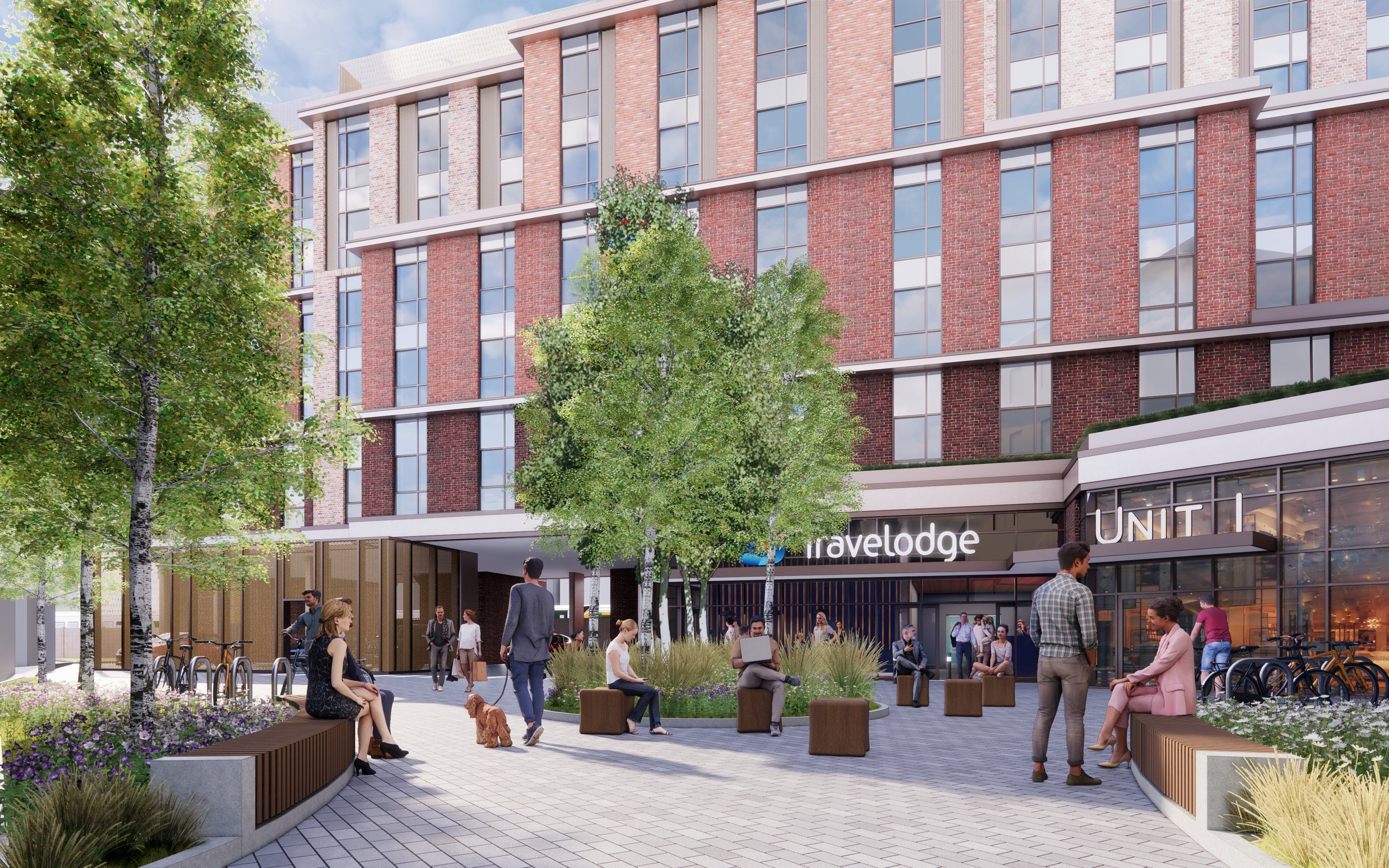
The hotel sits off Empire Mews, behind the high street, around a new landscaped piazza. The consent takes the entrance and reception through 225 Streatham High Road — putting the front door on the high street rather than down a side road, which is the difference between a hotel people find and one they don’t.
Computer-generated images by Mountford Pigott LLP. Indicative artist’s impressions of the consented scheme; the building as constructed may differ materially.
The gap
The case for a hotel here is not the building. It is that a district of south London with a mainline station has no branded budget hotel in it at all.
Lambeth’s own published hotel register tells the story better than we can. The borough is well supplied — but almost entirely at the top end of it. Sixty-nine per cent of Lambeth’s hotel rooms are in Waterloo and South Bank, and a further nineteen per cent in Vauxhall. All five Streatham wards together hold 80 rooms — 1.4% of the borough’s stock, in a single independent two-star.
The nearest branded budget hotels are a mile and a half away, in another borough.
Each bar is drawn to scale. The green sliver on the right — one and a half per cent of the borough's hotel stock — is the whole of Streatham. The rest sits eight miles north, around Waterloo, the South Bank and Vauxhall.
The nearest are Travelodge Balham and Premier Inn Tooting, both around 1.55 miles away and both in Wandsworth. Neither serves Streatham.
The Leigham Court Hotel — an 80-room independent two-star on Leigham Court Road, a kilometre from the site. That is the entirety of Streatham’s hotel supply.
Lambeth’s monitoring records zero hotel rooms under construction and zero unimplemented consents across all five Streatham wards.
Streatham station, Zone 3, Southern and Thameslink. Direct to Blackfriars and Farringdon four times an hour, London Bridge twice. Farringdon puts the Elizabeth line one change away.
| Nearest hotels | Rooms | Distance from site | Borough |
|---|---|---|---|
| Leigham Court Hotel — independent, 2-star | 80 | 1.05 km / 0.65 mi | Lambeth (SW16) |
| Tulse Hill Hotel | 9 | 2.36 km | Lambeth |
| Travelodge London Balham | — | 2.50 km / 1.55 mi | Wandsworth |
| Premier Inn London Tooting | 96 | 2.56 km / 1.59 mi | Wandsworth |
| Clapham South Belvedere Hotel | 96 | 3.27 km | Lambeth |
| Premier Inn Brixton | 118 | 4.03 km | Lambeth |
| Premier Inn Clapham | 105 | 4.61 km | Lambeth |
Room counts and borough hotel stock from the Lambeth Local Plan — Hotels and Other Visitor Accommodation Pipeline 2022/23, published August 2024, data as at 31 March 2023. Distances are straight-line, computed from ONS postcode centroids against the site at SW16 2BF, and are not walking routes. Station distance is likewise straight-line; the architect describes the site as opposite Streatham station. Journey frequencies are typical off-peak services and should be verified against the current timetable. In fairness to the reader: Lambeth’s same monitoring reports the borough at 3,398 rooms completed and in pipeline against an indicative 2015–2041 requirement of 3,368 — that is, already met. The argument here is not that Lambeth needs more hotel rooms in aggregate; it is that its stock sits almost entirely in Waterloo, South Bank and Vauxhall, serving a different market from a Zone 3 district centre eight miles south.
The demand
A budget hotel is filled by people who have to be somewhere near, not people choosing a view. Streatham’s pull is St George’s in Tooting — one of the four major trauma centres for London, and one of the largest teaching hospitals in the country.
A hospital of that size runs on a constant flow of visiting families, relocating and agency staff, contractors and outpatients. That is Holiday Inn Express and Travelodge’s core midweek business, and St George’s is roughly two road miles from the door.
Figures from the St George’s University Hospitals NHS Foundation Trust Annual Report 2024/25 and NHS England bed data. St George’s is in Tooting, in the London Borough of Wandsworth, about two road miles from the site. In the interests of a straight picture: a Premier Inn opened in Tooting in 2021, closer to the hospital than this site — so a Streatham hotel captures overspill and the wider south-London flow rather than the hospital’s primary demand. Springfield Hospital, also in Tooting, is a mental-health trust whose catchment excludes Lambeth and is a weak generator of hotel demand; it is relevant as regeneration — a £300m-plus redevelopment delivering some 1,288 homes and a new 32-acre park opened in 2025 — rather than as a source of guests. City St George’s medical school is co-located with the hospital, but most of its 27,000 students are in Islington and its nursing programmes moved to Kingston University in 2022; the local student cohort is around 3,900 at the Tooting campus.
Connectivity
Streatham station is 124 metres from the site — across the road. Zone 3, Southern and Thameslink, and step-free since Network Rail installed two lifts in December 2023.
Wimbledon is ten minutes. Blackfriars twenty, London Bridge twenty-two, St Pancras thirty. Farringdon is on the same Thameslink service four times an hour, which puts the Elizabeth line one change from the hotel’s door — and Gatwick and Luton beyond it.
For a budget hotel, that is the whole proposition: City rates, Zone 3 costs.
One train, four times an hour. The same Thameslink service runs the other way to Wimbledon in 10 minutes.
| Direct from Streatham | Fastest | Trains per hour | Operator |
|---|---|---|---|
| Wimbledon | 10 min | 2 | Thameslink — Sutton loop |
| London Blackfriars | 20 min | 4 | Thameslink |
| London Bridge | 22 min | 2 | Southern |
| Farringdon — Elizabeth line interchange | ~24 min | 4 | Thameslink |
| St Pancras International | 30 min | 4 | Thameslink |
| City Thameslink | ~22 min | 4 | Thameslink |
| East Croydon | — | 2 | Southern |
| Herne Hill · Tulse Hill · Elephant & Castle | — | 4 | Thameslink |
Wimbledon (10 min), Blackfriars (20 min) and London Bridge (22 min) are fastest scheduled services; St Pancras (30 min) is an average. Farringdon and City Thameslink are shown as approximate: both sit between Blackfriars and St Pancras on the same Thameslink service, so their times are bounded by the two, but the operator’s journey planner does not publish a figure for them and we have not verified one. Frequencies are typical off-peak. Streatham station distance is straight-line from the site postcode; the architect describes the site as opposite the station. Step-free access completed December 2023 (Network Rail, £5m, Department for Transport Access for All). Note: London Victoria and London Waterloo are not served direct from Streatham — Victoria runs from Streatham Common, roughly a kilometre south. Streatham has no Underground station, and the Mayor has confirmed there are no proposals to extend the Tube to Streatham. All services should be verified against the current timetable.
The numbers
The five Streatham wards hold just under 64,000 people, inside a Lambeth of 317,000 — one of the most densely populated boroughs in England, with a median age of 33, two years younger than London and seven younger than England.
It is a well-qualified catchment. 63% of Lambeth households fall into ABC1, against 59% across London and 56% in England. 56% of residents hold degree-level qualifications, against London’s 47% and England’s 34%. Education is the one domain where Lambeth outperforms three-quarters of the country.
Streatham is the least deprived of Lambeth’s five neighbourhoods — though that is a statement about Lambeth, and the section below says what Lambeth is.
| Measure | Streatham / Lambeth | Comparison |
|---|---|---|
| ABC1 households | Lambeth 63.4% · Streatham 62.6% | London 59.3%, England 56.2% |
| Degree-level (Level 4+) | Lambeth 56.3% | London 46.7%, England 33.9% |
| Median age | Lambeth 33 | London 35, England 40 |
| Population, five Streatham wards | 63,698 (mid-2024) | 63,997 at Census 2021 |
| Population density | 84.5 per hectare | Top 2% most dense in England |
| Town centre tier | Major Town Centre | One of only two in Lambeth |
Sources: ONS Census 2021 via Nomis (TS001 population, TS067 qualifications, SG002 approximated social grade) and ONS mid-year population estimates to mid-2024. Streatham figures are the five Streatham-named Lambeth wards — Streatham Common & Vale, Streatham Hill East, Streatham Hill West & Thornton, Streatham St Leonard’s and Streatham Wells. Approximated social grade is published at borough and MSOA level only; the Streatham figure is a population-weighted aggregation of the five core Streatham MSOAs. Census Day was 21 March 2021, during a national lockdown, and ONS caution that urban and high-mobility populations may be atypically recorded.
The honest position on this catchment, because a serious investor will find it: Lambeth’s population has fallen since 2019, from roughly 329,500 to 316,900 by mid-2024 — a decline of about 3.8% while London grew 2.2%. The five Streatham wards are down about 5.7% over the same period. Lambeth is more deprived than 76% of local authority districts on the Indices of Deprivation 2025, more income-deprived than 82%, and has no neighbourhood in England’s least-deprived 10%. Four of the five Streatham wards sit below the Lambeth average for higher managerial and professional occupations. We make no claim of an affluent influx or of population growth; the qualification and social-grade figures above are the catchment as it stands, not a trend.
The place
The site is the old Hideaway — a 250-capacity jazz club that ran from 2009 until 2020, and which Lambeth’s own Local Plan describes as “renowned”, “a particular draw” that “regularly attracts customers from outside London”.
It sits in a town with a long habit of entertaining south London. The Streatham Hill Theatre — Grade II listed, built in 1929 to a design by W. G. R. Sprague, seating 2,800 — still stands a mile north. The Locarno Dance Hall opened the same year and ran, latterly as Caesars, until 2010.
The consent replaces the Hideaway with a smaller live music venue inside the hotel. That is not incidental to the scheme — it is how a hotel of this scale came to be acceptable on this site.
Streatham Hill Theatre: Grade II listed 1994, on the Theatres Trust “Theatres at Risk” register since 2018; it is a separate building from the former Caesars nightclub, which stood at 156–160 Streatham Hill and was demolished in 2015. The Hideaway is described in the present tense at paragraph 11.64 of the Lambeth Local Plan 2021. The live music venue is written into the permission itself — the consent is for a hotel “incorporating a sui generis live music venue unit at ground floor.” It is part of what was permitted, not an optional extra, and the consented venue is smaller than the club it replaces. The section 106 obligations are modest: employment and skills and travel-plan contributions and a low-traffic-neighbourhood payment, together around £47,000, plus construction-phase employment and travel-plan commitments.
Policy
Streatham is one of only two Major Town Centres in the London Borough of Lambeth — the other is Brixton. It has its own policy in the adopted Local Plan, and that policy names hotels.
Policy PN4 sets out the vision: Streatham’s role “will be supported and enhanced to create a vibrant and viable town centre with a diverse economy including retail, leisure, offices, hotels and housing.” Policy ED14(A) supports visitor accommodation in town centres.
And on the site’s own location — the land around Streatham station — the plan is more specific still.
Local Plan Policy PN4(G)(ii) — Streatham Central
That is the adopted development plan describing the area around Streatham station — where this site sits, 124 metres from the platform.
The same policy says the council “will encourage landowners to work together to bring forward appropriate redevelopment” of the area surrounding the station, and that mixed-use development with active ground-floor frontages will be supported.
A consented hotel opposite the station is not fighting the plan. It is the plan.
Quotations from the Lambeth Local Plan 2020–2035, adopted September 2021, Policy PN4 and paragraph 11.59. Policy support is not a grant of permission and does not bind the council in respect of any future application.
Network Rail completed a £5m accessibility upgrade at Streatham station in December 2023, installing two lifts. The Local Plan’s own criticism that the station lacked step-free access is now out of date.
Clarion and Hadley’s consented Streatham Vale scheme — 237 homes at 35% affordable, beside Streatham Common station — was sold to Barratt London in January 2026.
Streatham Hub — leisure centre, ice rink, homes and bus interchange — completed 2013. London Square’s residential-led scheme on the former Caesars site, with a new theatre, completed 2018.
Lambeth designates just two Major Town Centres. Streatham is one of them, with a strategic position in south London and its own dedicated Local Plan policy.
Sources: Lambeth Local Plan 2020–2035 (adopted September 2021), Policy PN4 and Policy ED14; Network Rail, December 2023; Clarion Housing Group, 14 January 2026. In the interests of a complete picture: the A23 through Streatham is a designated Air Quality Focus Area, Streatham has no Underground station, and parts of the town centre fall within a London Plan Strategic Area for Regeneration — a designation based on indices of deprivation. Investors should form their own view.
Optionality
The consent is a Travelodge. But it is not the only brand that has looked at 2 Empire Mews and wanted it.
Yeats holds letters of intent from Hampton by Hilton and Holiday Inn Express. Mountford Pigott have developed layouts to all three operators’ standards and rendered the scheme for each — the same building, three brands, three sets of operator economics.
An incoming equity partner is therefore not buying a single-operator bet. The consent is deliverable as it stands, and there is a live choice about who runs the hotel and on what terms.
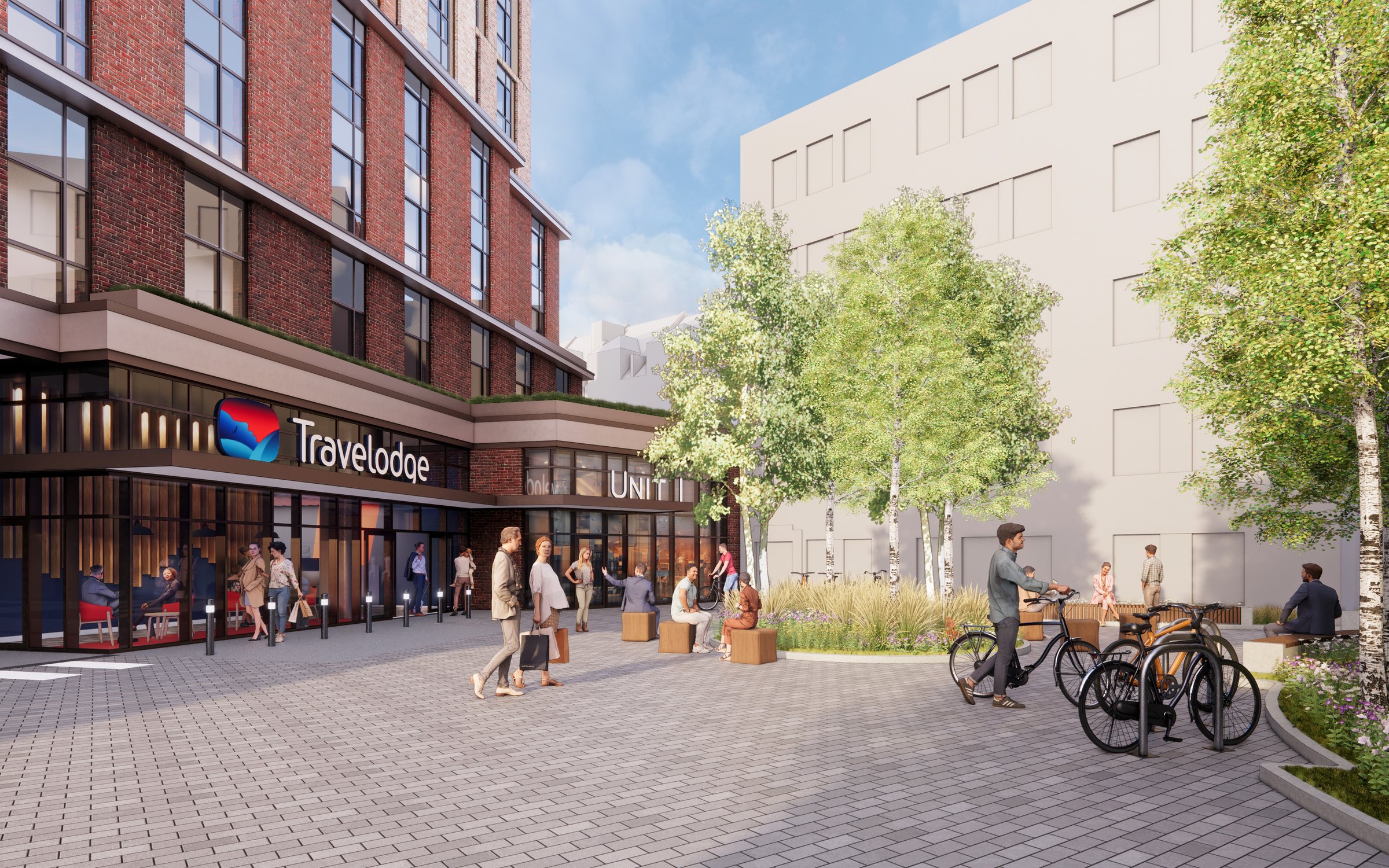
The 114-room scheme permitted by Lambeth. Deliverable today, with no further planning required.
Letter of intent held. Layout developed and the scheme rendered to Hampton standards.
Letter of intent held. Layout developed with IHG’s room specifications and rendered to HIEX standards.
All three work within the consented envelope — basement, ground and six storeys. The choice is commercial, not architectural.
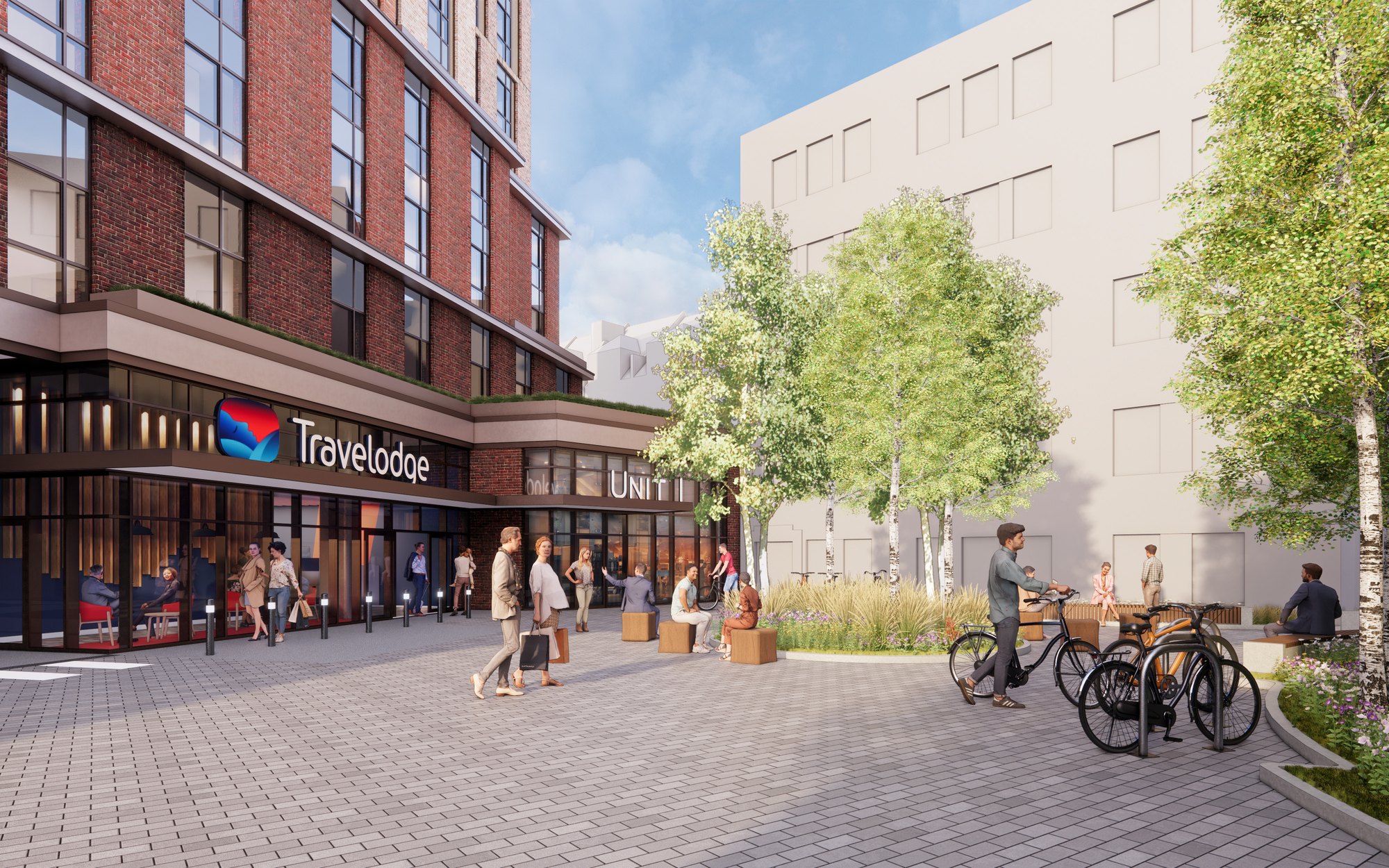
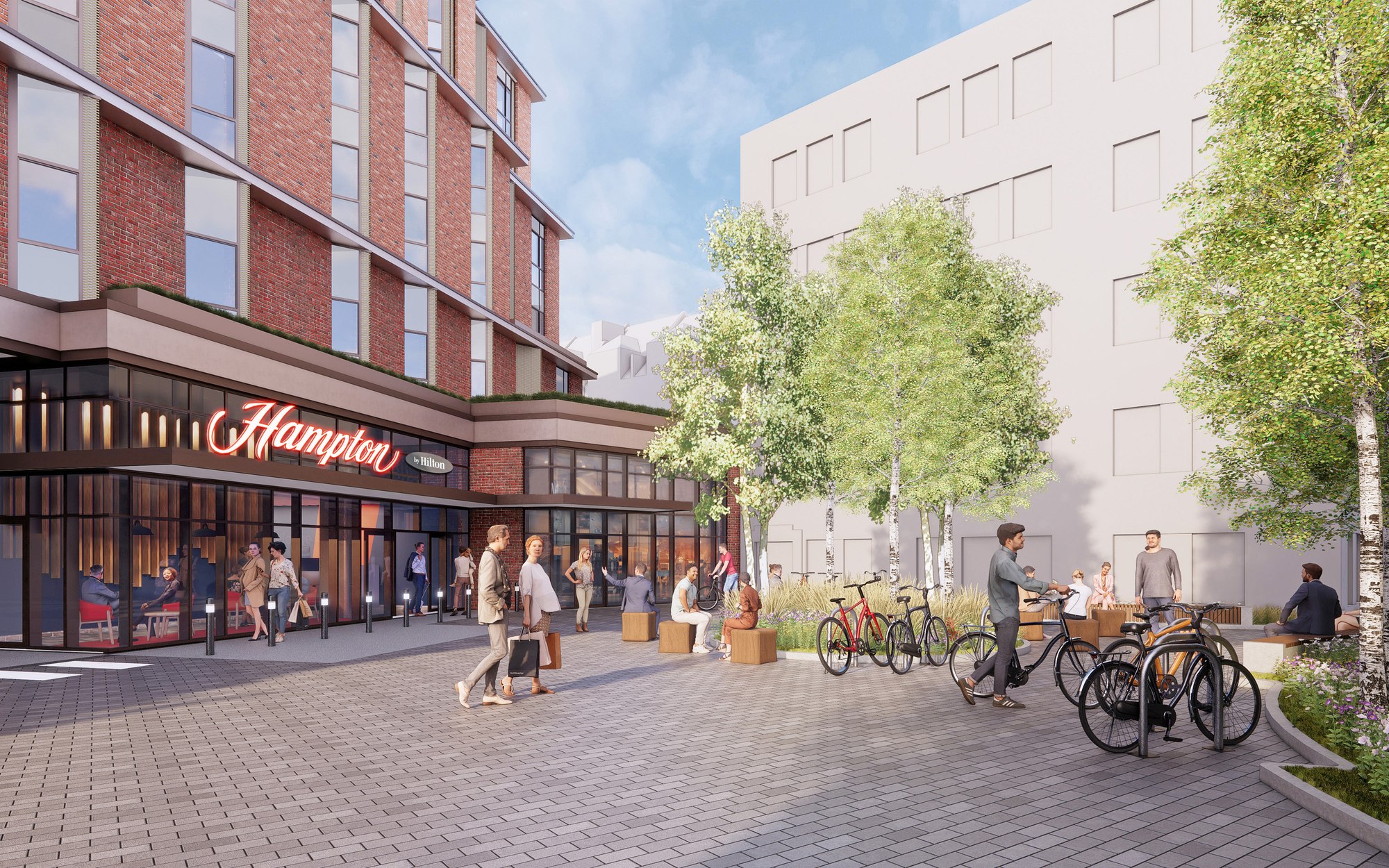
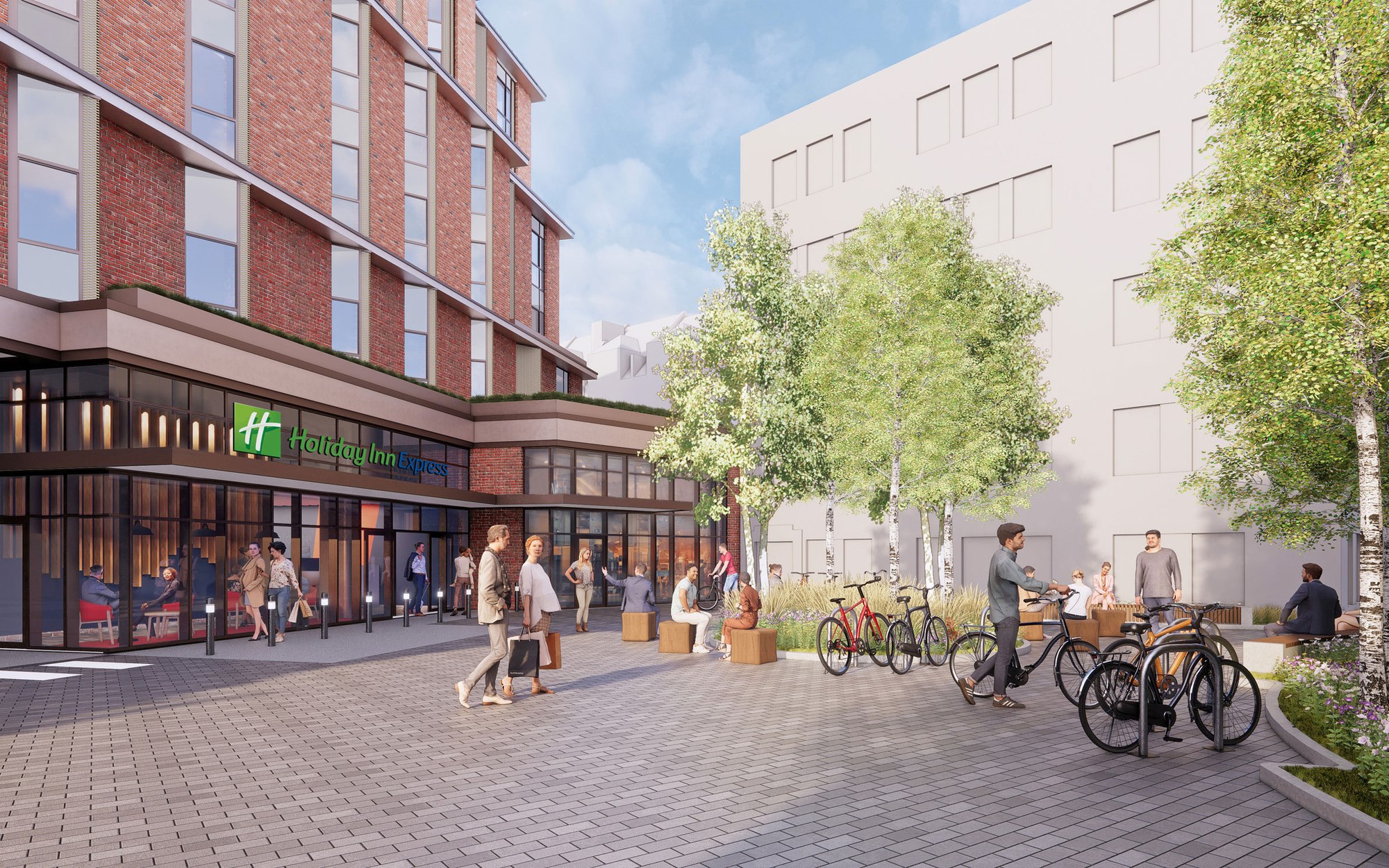
The same building, the same view, three operators. The consent is for the Travelodge; the Hampton by Hilton and Holiday Inn Express layouts have been developed to each brand’s standard.
Letters of intent are non-binding, are subject to contract, and no franchise or management agreement has been concluded with any operator. The permission granted by Lambeth under 22/01081/FUL is for the Travelodge scheme; delivering the site under a different brand would require the room layout to be revisited and may require a planning variation or a further application — an incoming partner should take its own planning advice on that before assuming a brand switch is cost-free. Brand names are used here to identify the operators from whom letters of intent have been received; no affiliation, endorsement or sponsorship by Travelodge, Hilton or IHG is implied or should be inferred.
Timing
The permission must be implemented by 21 February 2027 or it lapses.
That is the whole shape of this opportunity. A consented hotel opposite a mainline station is a rare thing; a consent with a deadline on it is a reason to move now rather than next year.
Implementation is under way. The pre-commencement conditions are being discharged — the step that allows the permission to be lawfully implemented, and the work that has to happen before February 2027 for the consent to survive.
For an equity partner, the work that usually takes two years and carries the real risk — getting a six-storey hotel through a London borough — has already been done and paid for.
The position
Yeats controls the site and the permission. The consented scheme is a 114-room Travelodge, designed by Mountford Pigott, who remain appointed. The site sits directly opposite Streatham station on Streatham High Road.
The pre-commencement conditions are being discharged now. What is needed is the capital to implement and build.
The permission expires 21 February 2027 unless lawfully implemented before that date. Discharge of the pre-commencement conditions is being progressed by London Leisure Services Ltd as the consent holder; no assurance is given that it will be achieved, and an investor should take its own planning advice on the implementation strategy, the pre-commencement conditions and the section 106 obligations. Any operator or franchise arrangement is subject to contract and is not concluded.
Next steps
This page sets out the site and the consent. It deliberately carries no financial information.
The development appraisal, the proposed structure, the operator terms, the programme and the returns are in a separate pack, sent on request. The technical data room — decision notice, conditions, section 106, the architect’s drawing set and the planning correspondence — sits alongside it.